Why Audience research is important
Audience research is important to media producers because it helps them to define who to aim their product towards. Audience research is carried out so that media producers can tailor and perfect their product so that it sells to a particular demographic. They might carry out research into a particular audience to produce a product for them; for example, a producer for BBC 3 would research into it's core demographic and create new content based on their findings. Another media producer might first produce a product and then research into the target audience in order to refine their product.How they use their findings
Media producers use audience profiling to target their product to the correct audience as efficiently as possible. The way they use their findings can determine how successful the product will be, if they did not use audience profiling then they may run the risk of mis-selling their product, misleading their audience or even offend a minority. The information they collect can be put to effect in a number of areas of their production - from who the target audience is to where the product will be distributed and how it is marketed. Producers will use audience profiling to determine who the target audience is and sculpt their product based on what they have found in their research, for instance; producers of X-Factor will make sure attractive boy bands get through because in their research they have found that the target audience: teenage girls, are more likely to watch based on their interests (some of which would be bands like One Directon or JLS which have a strong female teen audience and have proven to bring in a large portion of the viewership in previous seasons).Audiences are defined by a series of catagories, all audiences fall under a sub-catagory and it is these sub-catagories that help media producers to target their product.
Psychographics
Psychographics are the attitudes, behaviour patterns and personal interests of the audience. Media producers use psychographics to improve their product based on how they think their audience need it and how it will be best tailored to their target audience. Producers can discover psychographics by conducting questionnaires and focus groups. The psychographic of someone who might like the Game of Thrones could be someone who reads a lot, someone with an interest in violence, in fantasy, someone who might play role play games or do art as a hobby.
Socio-ecenomic Status
Socio-ecenomic status refers to the jobs, income and education of each household. This can be determined in part by geodemographics as the majority of people in the north of England are much poorer than those in the south and the number of unemployed in the north-east is greater than many other regions in the UK.
Socio-economic class can be categorised in either A, B, C1, C2, D and E - the income and the jobs of those in class A such as lawyers and bankers are much richer and have much higher paid jobs than those in the lower classes like C2 and D which have lower paid and more practical based jobs which require less qualifications like plumbing, building and cleaning. Media producers define their general audience as ABC1 as this represents most families - publishers put this information online so that advertisers can see which magazines to advertise their product in. Media producers use socio-economic status when profiling their audience, they can use the information to determine and refine the target audience, someone producing a documentary about unemployment would consider aiming it towards those lower down the socio-economic ladder.
Geodemographics
Audiences are defined by where they live; this is called a geodemographic. Where someone lives can say a lot about a person - their concern for the local area, their interest in it and also how rich or poor they are. Media producers use geodemographics to make sure they aim their product at the correct audience.
Someone from Teesside is likely to take interest in Inside Out: a regional documentary series on BBC1, because it shows the local area and gives an insight into things the TA are interested in - one episode featured interviews with people about their use of E-cigarettes from the Tyne-Tees area. Their choice to interview local people attracts a particular geodemographic who are concerned about the opinions of others in their community and because they can relate to them. It's no coincidence that in Middlesbrough alone 25% of adults smoke regularly - locals can relate to the documentary because it features anroducers use geodemographics to make sure they aim their product at the correct audience.
Age
Media producers use age to define which is the audience that their product is aimed towards. It is the most important factor when considering a target audience, this is because age defines the main interests of everyone. Audiences relate to things specific to their generation, for instance many older audiences like the Last of the Summer Wine because it features a mainly elderly cast but also because it showcases a comedy similar to the slapstick of yesteryear seen in earlier . Younger audiences will be attracted to shows like Bad Education because it is based in a school and features Jack Whitehall who is popular with younger audiences. Age can also define which type of humour an audience prefers - like reality TV, which has become popular since the late 90s and appeals to a late teen/early 20s age of viewer.
Age can also define the severity things like documentaries. Documentaries on BBC3 are often much lighter than those on BBC2 because they are aimed at a different audience. The documentaries on BBC3 focus on topics which the producers think the TA can relate to - drugs, sex, alcohol etc. Whereas documentaries aimed at an audience of 35+ will tend to focus on things that their TA can relate to - cowboy builders, antique auctions and older generations particularly will be interested in war documentaries. Over 60s are likely to also watch older films and TV shows, producers keep this in mind when choosing what they choose to repeat; before its rebrand, Channel 5 used to show repeats of old movies from the 50s and 60s - mainly Westerns, these films attracted an over 60s year old male audience likely because it reminds the TA of the time the films/TV shows were released.
Gender
Gender may be the joint most important consideration when defining an audience. Traditionally men and women lived very different lives and so have evolved very different interests based on what the media presents to them - for instance it has long been the case that boys' TV would feature action and violence whereas girls' TV would feature more light hearted content like fairies and princesses; similarly with adults - it is believed that the majority of men prefer violence and sex in media whereas women prefer romance and things they can relate to. It is only until fairly recently that gender is becoming a more transparent consideration in audience profiling. What I mean by this is that there are media producers who aim at stereotypical women: shows like Don't tell the Bride and Snog, Marry Avoid follow this approach of a very 'girly' aesthetic. In more sophisticated shows it is difficult to tell whether they are aimed at a male or female audience: Doctor Who for years had been aimed at an all male audience but in recent years, it sparked a massive female following and now a fair mixture watch the show devotedly. Similarly with Game of Thrones - watching it, one would assume it would be aimed at men; it features sex, gore, strong language and violence - yet the show still has a strong female audience - be it that they may be the target audience or not, they are still the audience.
Gender still plays a role in how media producers define their audiences though - producers still need to work to briefs that tell them to produce something aimed at either men or women and producers still work on ideas which they have to market to companies, advertisers and audiences as male or female orientated. Producers aim media at a specific audience for safety; it is much more efficient making something aimed primarily at men and have that one audience carry the viewership of the show than produce something which appeals to both men and women without loosing a large amount of the audience and risk failing. Not that producers don't take risks, many shows manage to appeal to both genders without playing on gender stereotypes - the IT Crowd features an almost all male cast with barely any women in it but because of the way the humour is written and the way the characters are portrayed, it manages to appeal to both genders while poking fun at gender stereotypes therefore making it generally likeable by everyone.
Sexual Orientation
Media producers will sometimes aim their product toward audiences of specific sexual orientation, they do this because they believe their product will appeal to the niche audience and become popularised by those groups. People of a certain sexual orientation may be more likely to watch a film which they can relate to; typically in romance films, TV shows, magazines or books. TV producers may cast homosexual actors in their shows to appeal to that audience, this has been done in dramas like Doctor Who and Ashes to Ashes. Similarly with film, producers will exploit the use of gay characters to appeal to a gay audience, like in Cloud Atlas. Other films and TV shows will appeal specifically to a gay and lesbian audience - Christopher and his kind, Kill your darlings and Blue is the warmest colour are all examples of this, they all feature homosexual romance as their main selling point as opposed to other films which may just include homosexual characters to gain a larger audience. Netflix has also exploited this niche market, it features 'Gay and Lesbian Films' as a part of it's categorisation - almost all the films in the list are romances, this shows that they were specifically selected by Netflix for the niche audience - by doing this they will likely get more subscriptions from gay and lesbian consumers and increase profit.
Publishers will produce magazines aimed at a gay and lesbian audience for the same reason. While the content of a gay magazine may be similar to any other regular generic magazine, the advertisements may be more specific to the target audience. Some of the content would be different too: to appeal specifically to this audience, some producers would make sure to feature only gay or lesbian contributors or journalists, interviews with popular gay figures like popular activist Ian McKellen or use over-sexualised images or vocabulary - this could be seen by some as stereotypical but producers choose to do this because it sells well.
Mainstream
Mainstream media is when a trend is created and followed by other similar companies. For instance, when Channel 4 began showing dramas like Skins with 18-25 year old actors a trend was set and other producers started to produce similar dramas for Channel 4 like Glue, Utopia and Misfits because Channel 4 had made it mainstream.
Often companies will tell producers to follow the mainstream because they know it is popular and an easy way at making money. Channel 4 also popularised an interest in the gypsy community through it's My Big Fat Gypsy Wedding series, other companies like the BBC have followed the mainstream and also produced TV documentary shows based around gypsies like The Big Gypsy Eviction and Gypsy Child Thieves.
Alternately, a documentary appeared on BBC 1 about the lives of hoarders; Channel 4 exploited the popularity of that concept by combining it with a successful documentary mini-series about people with OCD that had been shown on Channel 4 around the same time - this created 'Obsessive Compulsive Cleaners' where two opposites are pitted against each other (another mainstream format - seen years earlier with Wife Swap and Super Size Vs Super Skinny).
Mainstream music's always played on radio stations. When popular mainstream artists release music, radio stations like Radio 1 are quick to start playing it - increasing the popularity of the music and setting the standard for similar stations like Capitol FM and Heart Radio who will play the same kind of music because they know it is popular as Radio 1 has a large listenership - using the same content to share in their success.
In film; producers or writers will pitch ideas to companies by comparing their ideas to successful or mainstream films so that they will fund the project. Film investors like to know if a film will be like something they know is successful because they like to be sure they will make money back off the project which is why many investors do not take risks - a risk was taken in producing 2001: A Space Odyssey and the film was not successful upon release (despite becoming a cult classic in later years) and the original version of Dune was not produced because at the time the idea was too radical and investors turned the project down - it was only since the popularity of Star Wars, Alien and other similar sci-fi films of the time that ideas from the movie were cannibalised and used in other films until eventually it was picked up - as a result of it being long overdue and producers changing it from what it was intended as, became massive failure. Harry Potter on the other hand set a strong mainstream for modern film producers and as a result of the franchise's success; has lead to the release of Twilight, Percy Jackson, Hunger Games and Maze Runner - with a movie adaptation of the Tripods in the making which will follow the same setup (even to the extent of changing one of the main characters to a girl - mimicking the 2 male, 1 female trio main character setup of the Harry Potter, Twilight and Percy Jackson films).
Media producers will almost always go with what is mainstream in their audience profiling. Mainstream is when a trend becomes popular to the point where it is exploited everywhere and becomes normal. An example would be TV talent shows - first popularised in Pop Idol (which came after a similar show called Popstars), Pop Idol became American Idol in the US and then in Britain X-Factor was made with a similar format with other similar shows like Britain's got Talent, Got to Dance, and the musical theatre competitions which ran from 2006-2010.
Alternative
Media producers produce films for a alternative audience because there is often high demand for new concepts and ideas which other producers can adapt or exploit if they become popular and end up being mainstream. The first to land an idea is often the most remembered - Harry Potter is massively more popular than the similar franchises which came after it, Alien is widely recognised for the way it was made as opposed to other similar movies which came after, The Twilight Zone is recognised for its anthology setup more than its successors like Inside No. 9 or Tales of the Unexpected. Many of Stanley Kubrick's films were alternative at the time they were written but they set the standard for similarly made movies which came after them. Much of Alfred Hitchcock's work was controversial at the time and, like Kubrick, his films were unlike anything anyone had ever seen.
Indie films are becoming mainstream but have long been an alternative form of film making - smaller companies fund alternative films because they could become successful and they could be a failure as many of the techniques and styles of these films are very different from the mainstream and support alternative conventions in how they are made; the visual style adopted by Wes Anderson in his earlier indie films are a signature to his directional style and still follow in his later more expensive films.
Other, smaller film producers like Alejandro Jodorowsky produce art house films which are extremely alternative and often don't become mainstream because of the extremity of their surrealism, though producers fund art projects because they attract a small audience and because some do become successful.
In television, TV producers will make a pilot or a backdoor pilot in which they will demonstrate a typical episode of their series or produce a standalone episode which could spawn a series if the company funds it further. TV companies do this because it is cheaper to spend a small amount on a single pilot than spending a large amount of money on an entire series which may be unsuccessful. Fox funded a TV movie of Doctor Who in 1996 which served as a backdoor pilot for a series but it was never realised because the American audience was not as large as they had expected it to be.
BBC funded a standalone sketch show episode called MeeBox which aired on BBC3 but was never picked up because of it's unusual comic stylings - the episode was later uploaded to YouTube, where it received much praise as the comedy used in the show was typical to that which is popular on YouTube and so appealed to that alternative audience.
Much alternative media does appeal to users of YouTube, the platform allows independent filmmakers to experiment with filmmaking on a low budget and as a result, much of modern alternative film and comedy comes from YouTubers.
Niche
A niche audience is much smaller than that of a mainstream audience. Media bodies produce for a niche audience because they wish to spearhead or lead that market in the hopes of gaining a mass following in it or having a devoted audience. If a niche market becomes mainstream then the companies that capitalise on it first are likely to be the ones making the most profit out of it.
Total Carp Magazine is aimed towards a niche audience of 40+ year old men interested in carp fishing - as the audience for this magazine is so small, the publisher can exploit their interest in carp to get them to buy the magazine.
DJ magazines are aimed at a niche audience because only a small portion of people are interested in their content which ranges from artists to DJing equipment like mixing boards - something which some DJs would find incredibly useful.
BARB is the Broadcasters' Audience Research Board - it records television ratings and compiles audience measurement for TV companies. They record what people watch via a small implant inside the TV of participating viewers; which records the programmes they watch, the number of viewers is recorded by pressing a button on the remote control – each individual participant represents over 5,000 people. Participants are given a survey which they must complete - the survey asks for information about their lifestyle - this is so they can create psychographic profiles for their audiences. They do this by asking questions about their media intake outside of TV, their shopping, how many cars they own and what activities they do - among other questions. Knowing these things can help BARB determine the income of the audience, their personal preferences or the time they have and what they do with it, as well as how this relates to their viewing habits.
BARB creates demographics for it's audiences, media producers use these demographics in their research. The example below shows the number of individuals of certain ages and genders who watched at least 3 minutes of TV each year - the table shows that the audience for TV has remained at a constant since 2003.
Media producers use BARB to find out which kinds of programmes people watch and which channel it would be best to pitch their product to (such as crime drama would be best pitched to ITV and historical drama would be best marketed to BBC1 or a teen drama on E4, BBC3 or CBBC). Media companies use audience research like this to see which shows are mainstream and which shows are popular. Without BARB, companies would not know which shows to focus most of their money on, if a project they fund heavily is under-performing then they need to decide whether to axe it or not. BARB tells media producers which shows people watch most - the results can be filtered by date, time, channel and location - using BARB, producers can determine geogemographics and work out what is mainstream.
RAJAR stands for Radio Joint Audience Research. RAJAR is an audience measurement system, it records the number of people who tune in to a particular station and what time. RAJAR is owned by BBC and RadioCentre, who use it to see which of their programmings are popular. Media producers could use the research carried out by RAJAR to find out if some radio stations are attracting the right audience and which ones attract the largest audiences – for example, a company might find that they would like to advertise on Absolute Radio because they believe their product appeals to the station’s listenership.
Alternately, if BBC are facing budget cuts then they can see which of its stations are under performing; recently they tried to shut down 6 Music, but the station was saved by it's niche audience - 6 Music broadcasts alternative music which appeals to a niche audience and it does face falling figures.
RAJAR conduct their research by having participants fill out listening diaries to see which shows they listened to and at what time - RAJAR also asks participants where they listened and how - this is to gain an understanding of what kind of people listen to each station and either help broadcasters produce content aimed more specifically toward their target audience (as BBC Radio 1 did when a large portion of their listenership was above the age of their TA - they introduced Nick Grimshaw to replace Chris Moyles; attracting a younger listenership).
RAJAR collects all this quantitative research and compiles it in charts and tables - this way media producers can see things lim peak listening times, how many people use mobile devices to listen or what percentage of the population listen to radio every week. They also compare this information with previous years so they can see differences in people's listening habits - for instance how 1.6% less people listen to the radio this year than in 2010 - or how 4% less people listen to radio on their TV this year but 12% more listen online.
ABC stands for Audit Bureau Circulations. ABC records the circulation figures of newspapers and magazines. They do this by recording each newspaper/magazine purchase, once this was done on paper but is now done digitally. ABC was set up by the Incorporated Society of British Advertisers but was later involved with IPA, PPA, NS and NPA due to its success. Advertisers use ABC to determine which newspapers/magazines their adverts would be seen most in and by the correct target audience – Doctor Who magazine contains adverts for sci-fi conventions and Big Finish audio dramas; oriented towards their 15-40 year old male TA, whereas Mojo magazine features car ads, aftershave ads and CD releases; tailored to their 40 year old male TA. Producers would use ABC to find which publications appealed to a niche market and which magazines were mainstream - this can help publishers looking to release a new magazine as well as advertisers looking for the correct target audience for their product and where to get the greatest amount of ad views.
Media producers need to profile their audiences because it prevents them aiming their product to the wrong audience or making small mistakes in their product which some of their audience might disagree with - a small minority of Game of Thrones' audience dispute the misogynistic representation of women and the gore but the majority of people who watch it believe that it is this which makes the show unique and stand out above PC - pre-watershed shows; if the producers did not correctly profile their audiences, they could have marketed it towards the wrong audience and people who do not like gore and sex on TV (or small children) could have ended up watching it as a result of poor advertising to the wrong audience.
Producers need to carry out quantitative and qualitative research to profile their audiences - they use a number of audience research sites to do this. They can use these sites to find out the popularity of similar products and find out where to release their own - be it on TV, radio, print or film. Qualitative research is where media producers look at psychographics. Qualitative research is about finding a better understanding of the personal interests of the audience in order to refine their product.
Focus groups are where media producers present their product to a body of random people from different racial and geographical backgrounds and from different social hierarchies. This group of people will participate in tasks and games and will offer feedback on how they think the product could be improved and what they like and dislike about it. Producers can take this information and use it to refine their product and capitalise on the positive aspects of it when they need to market it.
Producers would conduct interviews as part of their qualitative research as this is the most in-depth method of profiling their audience. Face to face interviews can cause people to be vey open about their feelings and opinions - something which producers could exploit in order to bring their audience closer to the product. For instance, they could use research conducted in interviews to produce documentaries about one or some of the topic raised in those interviews and refine some of their ideas based on what they have heard from the interviewee - be it that one person could have been deeply affected by something, the producer could record the reaction of the person responsible for use in the documentary. Face to face interviews can be used in marketing a product too, if someone reviews the product - a TV show, a movie, a book etc. then they could be interviewed and used as promotion for the product.
Questionnaires come in the form of online surveys and representatives asking questions in streets or busy areas. Questionnaires will ask information about the people taking part and about their interests and what they might like to see in a product similar to what the producer may work on based on their findings. A producer will use this information to detail a response featuring all of the audience profiling factors listed above, and this will help refine their product or produce a product based on their findings. They would get this information by asking questions like 'what is your age?' and 'what is your gender?' and then questions like 'what's your favourite TV show?' and then more complicated questions like 'is there anything you think should be represented on TV but isn't at the moment?'. For instance if a large number of people who participated noticed that there wasn't enough drama on TV to their taste and a reasonable portion of those people was over 60 year old women, then the producer may set about producing a TV drama with a target audience of over 60 year old women.
sources:
http://www.barb.co.uk
http://www.rajar.co.uk
http://www.abc.org.uk
www.netflix.com
Gender
Gender may be the joint most important consideration when defining an audience. Traditionally men and women lived very different lives and so have evolved very different interests based on what the media presents to them - for instance it has long been the case that boys' TV would feature action and violence whereas girls' TV would feature more light hearted content like fairies and princesses; similarly with adults - it is believed that the majority of men prefer violence and sex in media whereas women prefer romance and things they can relate to. It is only until fairly recently that gender is becoming a more transparent consideration in audience profiling. What I mean by this is that there are media producers who aim at stereotypical women: shows like Don't tell the Bride and Snog, Marry Avoid follow this approach of a very 'girly' aesthetic. In more sophisticated shows it is difficult to tell whether they are aimed at a male or female audience: Doctor Who for years had been aimed at an all male audience but in recent years, it sparked a massive female following and now a fair mixture watch the show devotedly. Similarly with Game of Thrones - watching it, one would assume it would be aimed at men; it features sex, gore, strong language and violence - yet the show still has a strong female audience - be it that they may be the target audience or not, they are still the audience.
Gender still plays a role in how media producers define their audiences though - producers still need to work to briefs that tell them to produce something aimed at either men or women and producers still work on ideas which they have to market to companies, advertisers and audiences as male or female orientated. Producers aim media at a specific audience for safety; it is much more efficient making something aimed primarily at men and have that one audience carry the viewership of the show than produce something which appeals to both men and women without loosing a large amount of the audience and risk failing. Not that producers don't take risks, many shows manage to appeal to both genders without playing on gender stereotypes - the IT Crowd features an almost all male cast with barely any women in it but because of the way the humour is written and the way the characters are portrayed, it manages to appeal to both genders while poking fun at gender stereotypes therefore making it generally likeable by everyone.
Sexual Orientation
Media producers will sometimes aim their product toward audiences of specific sexual orientation, they do this because they believe their product will appeal to the niche audience and become popularised by those groups. People of a certain sexual orientation may be more likely to watch a film which they can relate to; typically in romance films, TV shows, magazines or books. TV producers may cast homosexual actors in their shows to appeal to that audience, this has been done in dramas like Doctor Who and Ashes to Ashes. Similarly with film, producers will exploit the use of gay characters to appeal to a gay audience, like in Cloud Atlas. Other films and TV shows will appeal specifically to a gay and lesbian audience - Christopher and his kind, Kill your darlings and Blue is the warmest colour are all examples of this, they all feature homosexual romance as their main selling point as opposed to other films which may just include homosexual characters to gain a larger audience. Netflix has also exploited this niche market, it features 'Gay and Lesbian Films' as a part of it's categorisation - almost all the films in the list are romances, this shows that they were specifically selected by Netflix for the niche audience - by doing this they will likely get more subscriptions from gay and lesbian consumers and increase profit.
Publishers will produce magazines aimed at a gay and lesbian audience for the same reason. While the content of a gay magazine may be similar to any other regular generic magazine, the advertisements may be more specific to the target audience. Some of the content would be different too: to appeal specifically to this audience, some producers would make sure to feature only gay or lesbian contributors or journalists, interviews with popular gay figures like popular activist Ian McKellen or use over-sexualised images or vocabulary - this could be seen by some as stereotypical but producers choose to do this because it sells well.
Mainstream
Mainstream media is when a trend is created and followed by other similar companies. For instance, when Channel 4 began showing dramas like Skins with 18-25 year old actors a trend was set and other producers started to produce similar dramas for Channel 4 like Glue, Utopia and Misfits because Channel 4 had made it mainstream.
Often companies will tell producers to follow the mainstream because they know it is popular and an easy way at making money. Channel 4 also popularised an interest in the gypsy community through it's My Big Fat Gypsy Wedding series, other companies like the BBC have followed the mainstream and also produced TV documentary shows based around gypsies like The Big Gypsy Eviction and Gypsy Child Thieves.
Alternately, a documentary appeared on BBC 1 about the lives of hoarders; Channel 4 exploited the popularity of that concept by combining it with a successful documentary mini-series about people with OCD that had been shown on Channel 4 around the same time - this created 'Obsessive Compulsive Cleaners' where two opposites are pitted against each other (another mainstream format - seen years earlier with Wife Swap and Super Size Vs Super Skinny).
Mainstream music's always played on radio stations. When popular mainstream artists release music, radio stations like Radio 1 are quick to start playing it - increasing the popularity of the music and setting the standard for similar stations like Capitol FM and Heart Radio who will play the same kind of music because they know it is popular as Radio 1 has a large listenership - using the same content to share in their success.
In film; producers or writers will pitch ideas to companies by comparing their ideas to successful or mainstream films so that they will fund the project. Film investors like to know if a film will be like something they know is successful because they like to be sure they will make money back off the project which is why many investors do not take risks - a risk was taken in producing 2001: A Space Odyssey and the film was not successful upon release (despite becoming a cult classic in later years) and the original version of Dune was not produced because at the time the idea was too radical and investors turned the project down - it was only since the popularity of Star Wars, Alien and other similar sci-fi films of the time that ideas from the movie were cannibalised and used in other films until eventually it was picked up - as a result of it being long overdue and producers changing it from what it was intended as, became massive failure. Harry Potter on the other hand set a strong mainstream for modern film producers and as a result of the franchise's success; has lead to the release of Twilight, Percy Jackson, Hunger Games and Maze Runner - with a movie adaptation of the Tripods in the making which will follow the same setup (even to the extent of changing one of the main characters to a girl - mimicking the 2 male, 1 female trio main character setup of the Harry Potter, Twilight and Percy Jackson films).
Media producers will almost always go with what is mainstream in their audience profiling. Mainstream is when a trend becomes popular to the point where it is exploited everywhere and becomes normal. An example would be TV talent shows - first popularised in Pop Idol (which came after a similar show called Popstars), Pop Idol became American Idol in the US and then in Britain X-Factor was made with a similar format with other similar shows like Britain's got Talent, Got to Dance, and the musical theatre competitions which ran from 2006-2010.
Alternative
Media producers produce films for a alternative audience because there is often high demand for new concepts and ideas which other producers can adapt or exploit if they become popular and end up being mainstream. The first to land an idea is often the most remembered - Harry Potter is massively more popular than the similar franchises which came after it, Alien is widely recognised for the way it was made as opposed to other similar movies which came after, The Twilight Zone is recognised for its anthology setup more than its successors like Inside No. 9 or Tales of the Unexpected. Many of Stanley Kubrick's films were alternative at the time they were written but they set the standard for similarly made movies which came after them. Much of Alfred Hitchcock's work was controversial at the time and, like Kubrick, his films were unlike anything anyone had ever seen.
Indie films are becoming mainstream but have long been an alternative form of film making - smaller companies fund alternative films because they could become successful and they could be a failure as many of the techniques and styles of these films are very different from the mainstream and support alternative conventions in how they are made; the visual style adopted by Wes Anderson in his earlier indie films are a signature to his directional style and still follow in his later more expensive films.
Other, smaller film producers like Alejandro Jodorowsky produce art house films which are extremely alternative and often don't become mainstream because of the extremity of their surrealism, though producers fund art projects because they attract a small audience and because some do become successful.
In television, TV producers will make a pilot or a backdoor pilot in which they will demonstrate a typical episode of their series or produce a standalone episode which could spawn a series if the company funds it further. TV companies do this because it is cheaper to spend a small amount on a single pilot than spending a large amount of money on an entire series which may be unsuccessful. Fox funded a TV movie of Doctor Who in 1996 which served as a backdoor pilot for a series but it was never realised because the American audience was not as large as they had expected it to be.
BBC funded a standalone sketch show episode called MeeBox which aired on BBC3 but was never picked up because of it's unusual comic stylings - the episode was later uploaded to YouTube, where it received much praise as the comedy used in the show was typical to that which is popular on YouTube and so appealed to that alternative audience.
Much alternative media does appeal to users of YouTube, the platform allows independent filmmakers to experiment with filmmaking on a low budget and as a result, much of modern alternative film and comedy comes from YouTubers.
Niche
A niche audience is much smaller than that of a mainstream audience. Media bodies produce for a niche audience because they wish to spearhead or lead that market in the hopes of gaining a mass following in it or having a devoted audience. If a niche market becomes mainstream then the companies that capitalise on it first are likely to be the ones making the most profit out of it.
Total Carp Magazine is aimed towards a niche audience of 40+ year old men interested in carp fishing - as the audience for this magazine is so small, the publisher can exploit their interest in carp to get them to buy the magazine.
DJ magazines are aimed at a niche audience because only a small portion of people are interested in their content which ranges from artists to DJing equipment like mixing boards - something which some DJs would find incredibly useful.
Where they find their research
Quantitative research is where media producers determine majorities and minorities in certain audience demographics. They conduct quantitative research by using sites like BARB, RAJAR and ABC.BARB is the Broadcasters' Audience Research Board - it records television ratings and compiles audience measurement for TV companies. They record what people watch via a small implant inside the TV of participating viewers; which records the programmes they watch, the number of viewers is recorded by pressing a button on the remote control – each individual participant represents over 5,000 people. Participants are given a survey which they must complete - the survey asks for information about their lifestyle - this is so they can create psychographic profiles for their audiences. They do this by asking questions about their media intake outside of TV, their shopping, how many cars they own and what activities they do - among other questions. Knowing these things can help BARB determine the income of the audience, their personal preferences or the time they have and what they do with it, as well as how this relates to their viewing habits.
BARB creates demographics for it's audiences, media producers use these demographics in their research. The example below shows the number of individuals of certain ages and genders who watched at least 3 minutes of TV each year - the table shows that the audience for TV has remained at a constant since 2003.
 |
| This is an example of the demographics created by BARB |
Media producers use BARB to find out which kinds of programmes people watch and which channel it would be best to pitch their product to (such as crime drama would be best pitched to ITV and historical drama would be best marketed to BBC1 or a teen drama on E4, BBC3 or CBBC). Media companies use audience research like this to see which shows are mainstream and which shows are popular. Without BARB, companies would not know which shows to focus most of their money on, if a project they fund heavily is under-performing then they need to decide whether to axe it or not. BARB tells media producers which shows people watch most - the results can be filtered by date, time, channel and location - using BARB, producers can determine geogemographics and work out what is mainstream.
RAJAR stands for Radio Joint Audience Research. RAJAR is an audience measurement system, it records the number of people who tune in to a particular station and what time. RAJAR is owned by BBC and RadioCentre, who use it to see which of their programmings are popular. Media producers could use the research carried out by RAJAR to find out if some radio stations are attracting the right audience and which ones attract the largest audiences – for example, a company might find that they would like to advertise on Absolute Radio because they believe their product appeals to the station’s listenership.
Alternately, if BBC are facing budget cuts then they can see which of its stations are under performing; recently they tried to shut down 6 Music, but the station was saved by it's niche audience - 6 Music broadcasts alternative music which appeals to a niche audience and it does face falling figures.
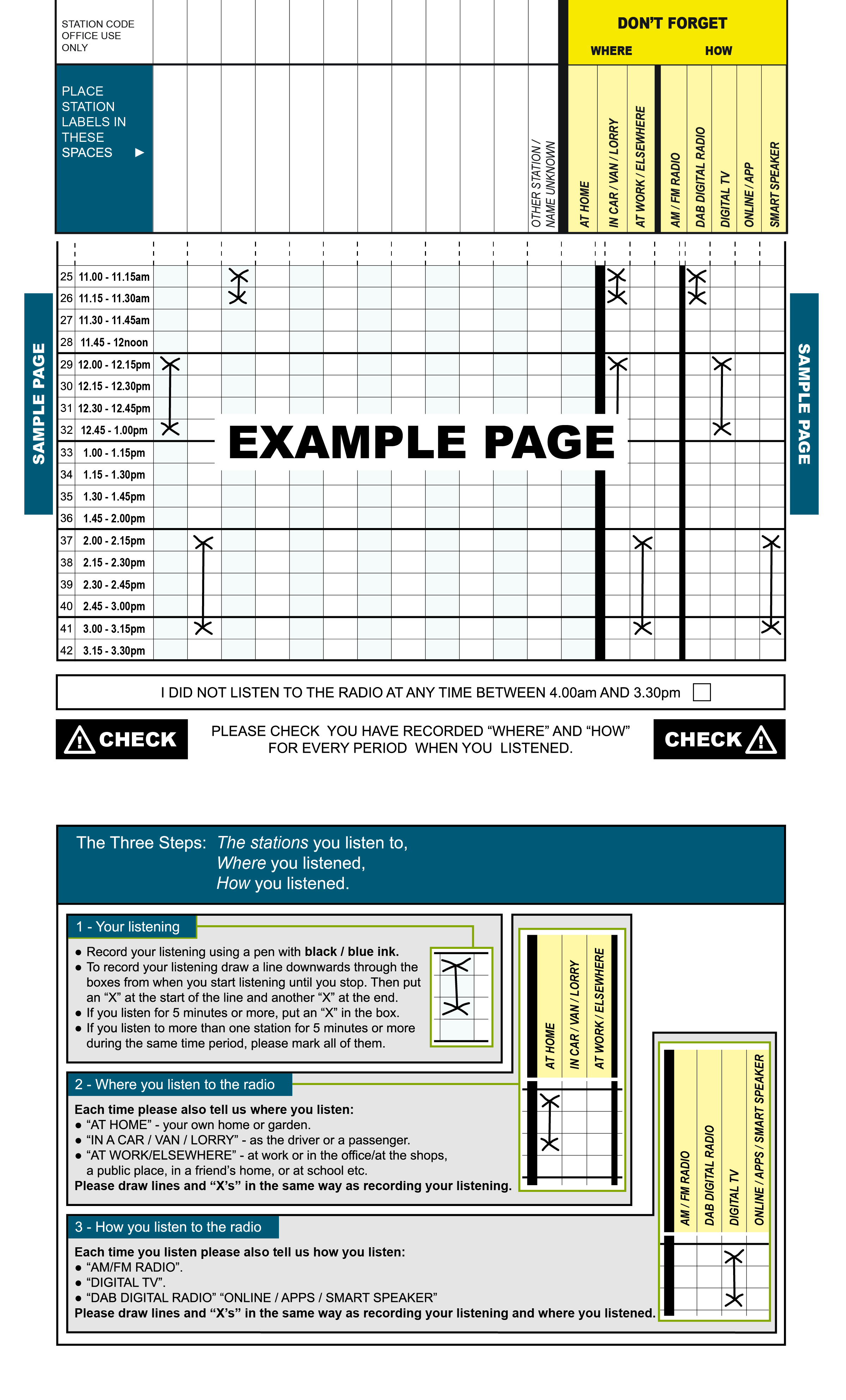 |
| RAJAR listening diary |
RAJAR collects all this quantitative research and compiles it in charts and tables - this way media producers can see things lim peak listening times, how many people use mobile devices to listen or what percentage of the population listen to radio every week. They also compare this information with previous years so they can see differences in people's listening habits - for instance how 1.6% less people listen to the radio this year than in 2010 - or how 4% less people listen to radio on their TV this year but 12% more listen online.
ABC stands for Audit Bureau Circulations. ABC records the circulation figures of newspapers and magazines. They do this by recording each newspaper/magazine purchase, once this was done on paper but is now done digitally. ABC was set up by the Incorporated Society of British Advertisers but was later involved with IPA, PPA, NS and NPA due to its success. Advertisers use ABC to determine which newspapers/magazines their adverts would be seen most in and by the correct target audience – Doctor Who magazine contains adverts for sci-fi conventions and Big Finish audio dramas; oriented towards their 15-40 year old male TA, whereas Mojo magazine features car ads, aftershave ads and CD releases; tailored to their 40 year old male TA. Producers would use ABC to find which publications appealed to a niche market and which magazines were mainstream - this can help publishers looking to release a new magazine as well as advertisers looking for the correct target audience for their product and where to get the greatest amount of ad views.
Why they carry out their research
 |
| Difference in listening hours per device in 2014 compared to 2013 |
Producers need to carry out quantitative and qualitative research to profile their audiences - they use a number of audience research sites to do this. They can use these sites to find out the popularity of similar products and find out where to release their own - be it on TV, radio, print or film. Qualitative research is where media producers look at psychographics. Qualitative research is about finding a better understanding of the personal interests of the audience in order to refine their product.
Focus groups are where media producers present their product to a body of random people from different racial and geographical backgrounds and from different social hierarchies. This group of people will participate in tasks and games and will offer feedback on how they think the product could be improved and what they like and dislike about it. Producers can take this information and use it to refine their product and capitalise on the positive aspects of it when they need to market it.
Producers would conduct interviews as part of their qualitative research as this is the most in-depth method of profiling their audience. Face to face interviews can cause people to be vey open about their feelings and opinions - something which producers could exploit in order to bring their audience closer to the product. For instance, they could use research conducted in interviews to produce documentaries about one or some of the topic raised in those interviews and refine some of their ideas based on what they have heard from the interviewee - be it that one person could have been deeply affected by something, the producer could record the reaction of the person responsible for use in the documentary. Face to face interviews can be used in marketing a product too, if someone reviews the product - a TV show, a movie, a book etc. then they could be interviewed and used as promotion for the product.
Questionnaires come in the form of online surveys and representatives asking questions in streets or busy areas. Questionnaires will ask information about the people taking part and about their interests and what they might like to see in a product similar to what the producer may work on based on their findings. A producer will use this information to detail a response featuring all of the audience profiling factors listed above, and this will help refine their product or produce a product based on their findings. They would get this information by asking questions like 'what is your age?' and 'what is your gender?' and then questions like 'what's your favourite TV show?' and then more complicated questions like 'is there anything you think should be represented on TV but isn't at the moment?'. For instance if a large number of people who participated noticed that there wasn't enough drama on TV to their taste and a reasonable portion of those people was over 60 year old women, then the producer may set about producing a TV drama with a target audience of over 60 year old women.
sources:
http://www.barb.co.uk
http://www.rajar.co.uk
http://www.abc.org.uk
www.netflix.com
